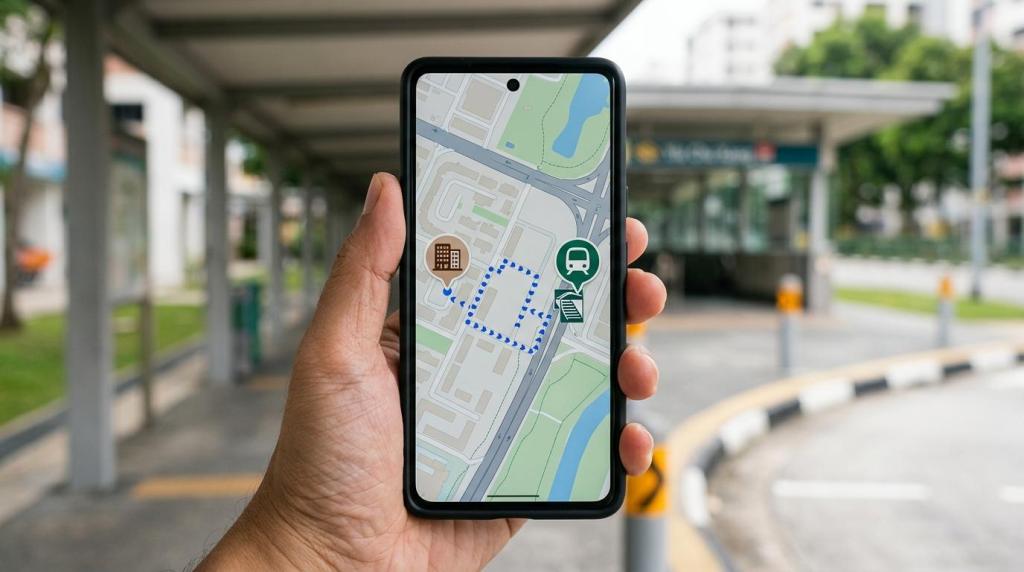
Executive condominiums near MRT stations solve a very practical problem in Singapore: daily travel friction. For HDB upgraders and first-time EC buyers, a shorter walk to the train often means better school runs, less dependence on cars, and a stronger resale story after the Minimum Occupation Period. That is why “EC near MRT” is not just a location preference, but a pricing, lifestyle, and risk-management decision. The key challenge is separating true walkable convenience from marketing claims tied to future stations or optimistic walking times.
What counts as an EC near MRT in Singapore?
Yes, an EC is usually considered MRT-near if it is about 500m away or around 5 to 8 minutes on foot. HDB and URA do not impose a consumer-facing benchmark, so buyers should verify with OneMap and actual station exits.
In practice, “near MRT” can mean three very different things. First, there are ECs beside an existing station, where convenience starts on day one. Second, there are ECs near a confirmed future station, where value depends on timeline and execution. Third, there are projects marketed with a short walk time, but the route may involve major roads, unsheltered stretches, or indirect pedestrian access.
A common mistake is assuming brochure language equals real usability. A five-minute walk in Tampines with sheltered paths feels very different from a five-minute walk across busy roads in a new estate. If the station is future-facing, treat current convenience and future upside as separate benefits.
Why does MRT proximity matter so much for EC buyers?
MRT proximity lifts both liveability and buyer demand. EdgeProp survey data and a real estate agency in Singapore market analysis point in the same direction: Singapore buyers pay more for convenience, especially when transport, retail, and schools cluster around one node.
EdgeProp reported that respondents were willing to pay more for homes near transport and convenience nodes. About some were willing to raise their budget by at least 10% for direct MRT access, while others were willing to pay 10% more for walking distance to an MRT station. That matters for ECs because the core audience is heavily owner-occupier led.
For EC buyers, MRT access does four things at once. It reduces commuting uncertainty, widens the future resale pool, improves rental appeal after MOP, and supports price resilience when newer supply enters the market. If a project is also near a mall, bus interchange, or established schools, the transport premium usually becomes stronger.
The trade-off is clear. You often pay a higher psf upfront, and sometimes accept a busier environment. Yet if your household depends on public transport, that premium can be rational rather than emotional.
What are the best ways to research EC near MRT options in Singapore?
The best research stack combines a specialised EC portal, HDB rules, and map-based verification. Executive Condominium Singapore , HDB, and URA each answer a different part of the buying question.
If you rely on only one source, you will probably miss either policy details, live project updates, or genuine walking distance. A strong shortlist usually starts with project discovery, then moves to eligibility, then ends with map-based and price-based checking.
- Executive Condominium Singapore: focused EC-only resource for pricing, floor plans, availability, eligibility guidance, affordability checks, and showflat arrangements.
- HDB: official source for EC eligibility rules, buyer schemes, and core purchase conditions.
- URA and OneMap: useful for transaction context, site planning, and real-world distance checking.
- Official developer materials: best for approved site plans, unit mix, and launch specifics.
Pro tip: use marketing sites to shortlist, then use official and mapping tools to verify. That sequence is faster and safer.
Which executive condos near MRT stations stand out today?
The strongest current examples are Esparina Residences near Buangkok MRT and The Tampines Trilliant near Tampines MRT. Among newer launches, Aurelle of Tampines, Rivelle Tampines, Novo Place and Otto Place stand out more for future MRT connectivity than immediate rail access.
For existing MRT convenience, four names consistently come up. Esparina Residences remains one of the clearest EC examples with genuine walkability to Buangkok MRT on the North East Line. The Tampines Trilliant benefits from proximity to the Tampines interchange and the deep amenity base of Tampines Central. The Brownstone and 1 Canberra are both closely associated with Canberra MRT and the convenience of the northern growth corridor.
For newer or upcoming projects, the story changes. Aurelle of Tampines is tied to future Tampines North MRT on the Cross Island Line, and market reports indicated roughly 90% of units were sold on launch weekend, showing how powerful the Tampines location narrative remains. Otto Place and Novo Place in Tengah are near future Jurong Region Line stations, which makes them more transformation-led than immediate-commute buys. Tenet also benefits from the future Tampines North transport story.
A common misconception is that newer always means better located. In the EC market, some older projects in mature transport nodes can be stronger MRT plays than newer projects in emerging towns.
How do existing-MRT ECs compare with future-MRT ECs?
Existing-MRT ECs offer certainty, while future-MRT ECs offer a development thesis. Canberra MRT and Buangkok MRT give immediate utility; Tampines North MRT and Tengah Park MRT offer potential that depends on delivery and precinct growth.
If you buy near an existing station, you can test the commute, measure the path, and estimate resale demand with fewer assumptions. This reduces location risk. Projects like Esparina Residences or 1 Canberra are easier to assess because their transport benefit is already operating.
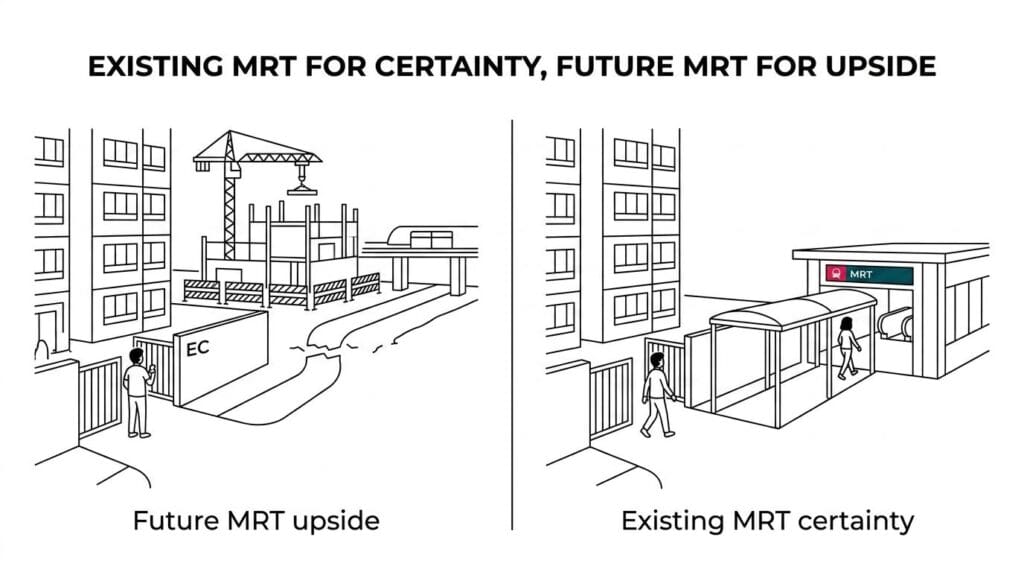
If you buy near a future station, the upside can be attractive, especially in places like Tampines North or Tengah. Yet the premium may already reflect part of that future benefit. If the station opens later than expected, or if the surrounding town takes longer to mature, daily convenience during the early years may feel weaker than buyers expected.
This is where time horizon matters. If you need immediate convenience, existing MRT access usually wins. If you can wait through precinct development and want entry into a newer estate, future-MRT ECs can still make sense.
How do MRT-near ECs compare with ECs farther from the station?
MRT-near ECs usually command a premium, but they also tend to have stronger demand depth. Buangkok and Tampines show the upside of connectivity; larger-site projects farther inland can compensate with space, quiet, or lower entry psf.
A real estate agency reported that the median unit price of new ECs rose from S$782 psf in 2016 to S$1,836 psf in early 2026, a 134.8% increase. MRT access is not the only reason, but it is one of the strongest location multipliers inside that broader price trend.
A station-near EC often wins on commute efficiency, car-lite living, tenant appeal after MOP, and resale defensiveness. A farther EC may offer better value per square foot, a quieter setting, or bigger internal layouts for the same budget. If your family works from home most days and drives regularly, paying a large MRT premium may not improve your real lifestyle. If two adults commute daily and the children depend on public transport, the same premium may be fully justified.
Pro tip: compare the total lifestyle cost, not just purchase price. Lower transport costs, fewer ride-hailing trips, and better time savings can offset part of a higher entry psf.
How can you verify whether an EC is truly within walking distance of an MRT?
You should verify using OneMap, Google Maps, and the actual station entrance. OneMap is useful for Singapore walking routes; developer brochures and portal pages are useful only as a starting point.
Step 1 is to measure from the project’s pedestrian gate, not the centre of the site. Large developments can add two to four minutes from your block to the estate exit, especially if your chosen stack sits deeper inside the compound.
Step 2 is to check the exact station access point. A 400m straight-line distance can become a 650m real walk if the nearest entrance sits across a major road or if there is no direct crossing. This matters more in newer estates and roads still being built out.
Step 3 is to test the walk during the time you would actually use it. Morning sun, shelter, traffic-light waits, and stroller access can change the experience. A common buyer mistake is to count only distance and ignore route quality.
How can you decide whether the MRT premium is worth paying?
The MRT premium is worth paying if it improves both daily utility and exit demand. URA transaction context and your MSR-based affordability test should be read together, not separately.
Step 1 is to estimate how much extra you are paying for rail access. Compare the EC not only with another EC in the same town, but also with a similar-sized option farther from the station. If the difference is modest, the convenience premium may be efficient.
Step 2 is to convert convenience into money and time. Two adults saving 20 to 30 minutes a day each can recover a meaningful lifestyle benefit over five years. Add likely transport savings if you can reduce car use, parking spend, or ride-hailing dependence.
Step 3 is to ask whether the resale pool remains broad after MOP. MRT-linked homes usually appeal to both owner-occupiers and tenants. If the project is already priced at an aggressive premium and the station is still future-facing, be stricter. If the project has existing MRT access plus mature amenities, the premium is often easier to defend.
How can HDB upgraders assess affordability for an EC near MRT?
HDB upgraders should test eligibility first, then borrowing power, then cash flow resilience. HDB rules, bank loan assessments, and stamp duties can change the answer quickly.
Step 1 is to confirm EC eligibility and buyer status. Check household income ceiling, citizenship mix, family nucleus, and whether a resale levy may apply. Buyers sometimes focus on location first and realise later that the financing structure is the real limit.
Step 2 is to run a realistic affordability model. Include down payment, monthly instalments, Buyer’s Stamp Duty, legal fees, renovation, and moving costs. Use a stress-tested interest rate, not only the current marketed rate. If your monthly numbers work only in a best-case scenario, the budget is too tight.
Step 3 is to keep a buffer for the first few years. A practical benchmark is to preserve several months of emergency liquidity after completion costs. Common misconception: qualifying for the loan means the EC is affordable. True affordability means your household can handle rate changes, school costs, and one temporary income shock without distress.
What trade-offs should buyers expect in an EC beside an MRT?
The main trade-offs are higher price, more activity, and greater sensitivity to stack selection. Canberra and Tampines show the upside of convenience, but station-adjacent living is never purely about distance.
Many of the downsides can be managed if you choose the right facing and level. A stack facing an internal pool or landscape buffer often feels very different from one facing the station approach road.
- Noise: rail movement, buses, and road traffic can affect lower or outward-facing stacks.
- Premium psf: easier commutes often mean a higher entry price.
- Foot traffic: busy station precincts can feel less private near the edge of the site.
- Heat and activity: more urban nodes can mean less of the quiet, tucked-away feel some families want.
Pro tip: do not judge the whole project by one noisy stack. Site plan reading matters almost as much as MRT distance.
Which MRT-linked EC locations look strongest for buyers right now?
Tampines, Sengkang, and Canberra remain strong because transport links meet real amenity depth. Tengah is promising too, but it is still a future-connectivity story rather than a mature-node story.
For buyers comparing locations, it helps to separate “proven convenience” from “planned convenience”. Both can work, but they suit different risk appetites and move-in needs.
- Tampines: interchange access, retail depth, schools, and strong upgrader demand.
- Buangkok and Sengkang area: established daily convenience with proven resale interest.
- Canberra: strong liveability for north-region buyers who want MRT access without central-region pricing.
- Tengah and Tampines North: transformation upside, newer stock, and future rail benefits, with more patience required.
If you want immediate transport certainty, mature MRT nodes still set the benchmark. If you want a newer estate with potential re-rating as infrastructure completes, future-MRT ECs deserve a close look, but only after a careful affordability and timing check.
Disclaimer: While reasonable care has been taken in preparing this website, neither the developer nor its appointed agents guarantee the accuracy of the information provided. To the fullest extent permitted by law, the information, statements, and representations on this website should not be considered factual representations, offers, or warranties (explicit or implied) by the developer or its agents. They are not intended to form any part of a contract for the sale of housing units. Please note that visual elements such as images and drawings are artists’ impressions and not factual depictions. The brand, color, and model of all materials, fittings, equipment, finishes, installations, and appliances are subject to the developer’s architect’s selection, market availability, and the developer’s sole discretion. All information on this website is accurate at the time of publication but may change as required by relevant authorities or the developer. The floor areas mentioned are approximate and subject to final survey.
