
Families do not buy an Executive Condominium for facilities alone. In Singapore, school access can shape daily travel, Primary 1 planning, resale demand and even how long a household stays in the home. The problem is that many buyers treat “near school” as a simple map label, when the real decision needs three layers at once: school quality signals, admission distance, and whether the EC still fits the budget after grants, loan limits and family-size needs.
For EC buyers, especially HDB upgraders, the best choice is rarely the cheapest project or the nearest school in isolation. It is the project that balances school proximity with town maturity, MRT access, efficient layouts and a realistic payment structure.
Why do good schools matter when buying an EC in Singapore?
Yes. In Tampines and Bukit Batok, school access supports EC demand because family buyers usually judge commute time, admission distance and resale resilience together.
School proximity works as a demand amplifier, not a standalone magic factor. If an EC sits near sought-after primary schools and also has MRT access, supermarkets and family-sized layouts, it usually attracts stronger owner-occupier demand. That is one reason Tampines ECs like Rivelle Tampines have drawn such strong take-up.
The value case matters too. A real estate agency in Singapore noted that in 2024, the median transaction price of a new OCR condo unit sized 900 to 1,000 sq ft was 42% higher than a comparable new EC unit. If a family can access a school-focused location through an EC rather than a private condo, the savings can be substantial while facilities remain condo-style.
A useful rule is simple. If school access comes with a mature estate, then pricing support is usually stronger. If school access comes in a newer town without the same amenity depth, then value may take longer to show up.
Which school signals actually matter for EC buyers in Singapore?
MOE does not publish one official ranking table for primary or secondary schools. So buyers need to use accepted proxies: SAP status, GEP availability where applicable, autonomous or independent status for older students, affiliation pathways and historical parent demand.
For EC buyers, primary schools usually matter more than secondary schools because Primary 1 admission distance has a direct housing effect. In Tampines, St. Hilda’s Primary was often cited because the school carry recognised signals. In the west, Princess Elizabeth Primary matter more for proximity and day-to-day practicality than for prestige branding.
Common misconception: a “good school” is not always the “right school”. If the family prioritises Chinese language culture, affiliation, or lower commute stress, then the best fit may differ from the most talked-about name.
What are the best EC shortlists near good schools right now?
Tampines leads. Executive Condominium Singapore, Rivelle Tampines EC and Otto Place EC are strong starting points for buyers who want current EC data plus school-linked screening.
If your goal is to narrow choices fast, start with a shortlist that combines project facts, school ecosystem and affordability rather than relying on marketing maps alone.
- Best starting point for comparing current EC pricing, floor plans, eligibility rules and school-linked project shortlists before booking a showflat.
- Aurelle of Tampines: Strong all-round school-driven pick with nearby Tampines schools, a mature-east setting, and launch demand around 90% sold at an average of about $1,766 psf.
- Rivelle Tampines: Premium Tampines option with several primary schools cited within 1km in market reporting, and about 92.5% sold at launch at roughly $1,893 psf.
- Lumina Grand: Better value west-side choice at about $1,464 psf launch average, with access to Princess Elizabeth Primary, Dazhong Primary and the wider Bukit Batok school cluster.
- Novo Place & Otto Place: Strong for buyers who accept a still-maturing school ecosystem in exchange for Tengah’s longer-term planning upside, with launch pricing around $1,654 psf onwards.
Coastal Cabana also belongs on a watchlist for east-side buyers, though public data remains thinner than for the Tampines and Bukit Batok launches.
How do you verify whether an EC is truly near your target school?
Use official addresses. MOE SchoolFinder and OneMap are more reliable than brochure circles or agent drive-time claims.
Start with the school, not the EC. Check the official school name, address and whether the school has any status or affiliation that actually matters to your family.
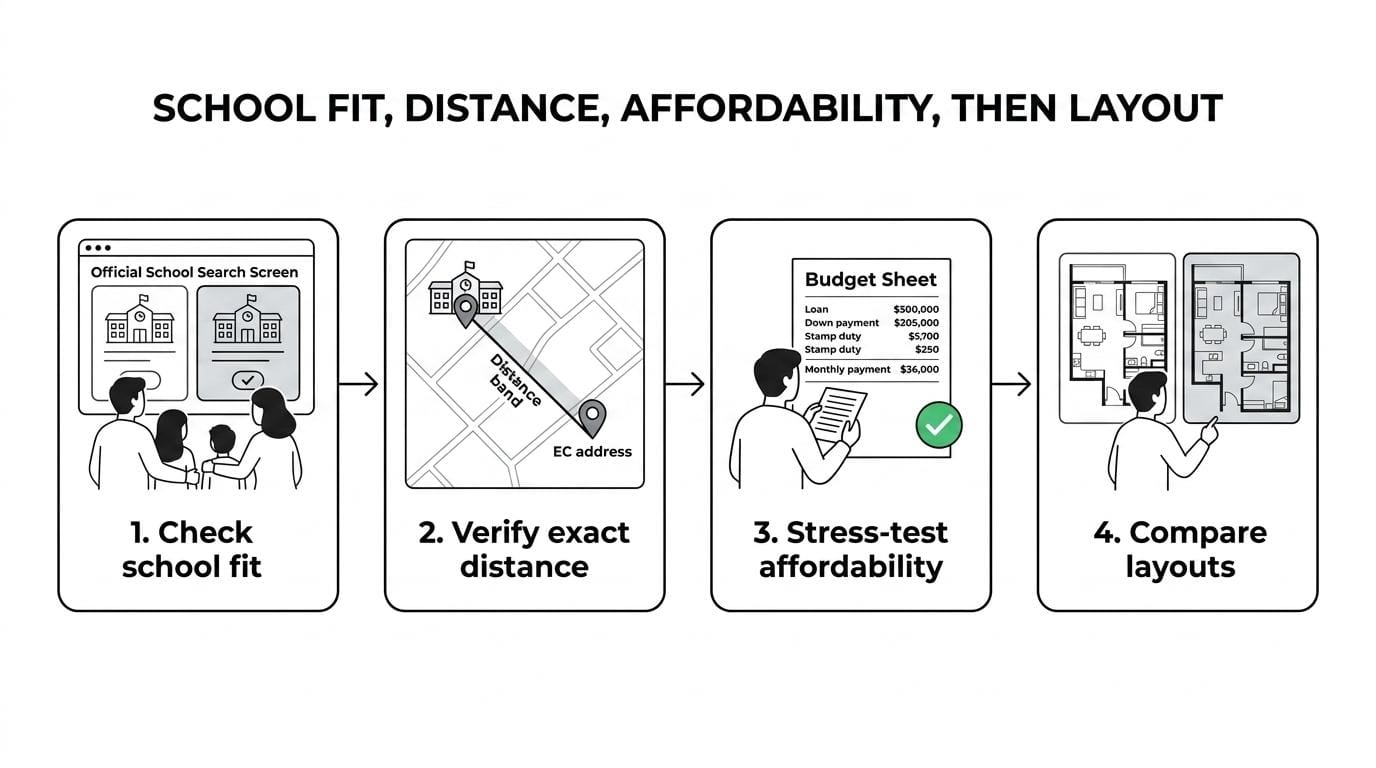
Step 1: Confirm the school profile.
Use MOE SchoolFinder to verify the exact campus, programmes and whether the school is primary or secondary. A famous school name is useless if it is the wrong campus or level.
Step 2: Check the EC’s exact postal address or the final project address once released.
Then test distance using OneMap or other official mapping tools. For Primary 1 planning, the key question is whether the home falls within the relevant home-school distance band, not whether the car ride looks short on a Sunday afternoon.
Step 3: Check timing and relocation risk.
If the project TOP date and the school’s location changes do not match your child’s registration year, your original assumption may fail. Pro tip: school relocation notices and future road links can change the real convenience picture more than buyers expect.
How should you calculate affordability for a school-focused EC purchase?
Start with loan limits. HDB rules, MAS TDSR and MSR matter more than a school-driven impulse purchase.
School-focused buying gets risky when households stretch too hard for a preferred address. The discipline is straightforward.
Step 1: Stress-test the loan.
For ECs, buyers still need to observe the income ceiling, plus financing rules like the 55% TDSR and 30% MSR where applicable. If the monthly payment only works at today’s lowest comfort level, then the school advantage may cost too much.
Step 2: Add the full acquisition cost.
Down payment, Buyer’s Stamp Duty, legal fees, renovation and moving costs can easily add six figures. A project that looks affordable at launch price alone may feel different after all entry costs are included.
Step 3: Compare livable cost, not only psf.
Aurelle and Rivelle sit at a very different price level from Lumina Grand. Yet the right comparison is monthly commitment for a family-size unit, school access and commute pattern together. Pro tip: if a 1km target forces long-term cash strain, the “good school” strategy can weaken family finances more than it helps schooling.
Is Tampines or Bukit Batok better for EC buyers who prioritise schools?
Tampines is stronger for school depth. Bukit Batok is stronger for entry value and still offers practical family-school options.
Tampines currently has the clearest school-led EC story. Aurelle of Tampines, Rivelle Tampines and even Tenet benefit from an established east-side ecosystem that includes St. Hilda’s Primary, Poi Ching, Tampines Primary and other familiar names, plus malls, transport and mature-estate convenience.
Bukit Batok is different. Projects like Lumina Grand and Altura do not ride on the same prestige-school narrative, but they still appeal to families who want nearby primary schools, a west-side commute and lower launch pricing than newer Tampines benchmarks.
If budget is the main filter, Bukit Batok usually wins. If school-network depth and mature-town liveability are the first priorities, Tampines has the clearer edge. The trade-off is obvious: stronger school branding tends to come with a higher psf and tighter competition.
Should you pick a mature-town EC or a newer Tengah EC for long-term value?
Mature towns are safer. Tampines has immediate liveability, while Tengah projects like Novo Place and Otto Place may offer longer-horizon upside as they are in a new township.
This is one of the clearest trade-offs in the EC market. Mature towns give buyers a visible school network, tested amenities and easier resale storytelling. New towns can offer fresher stock, modern planning and potentially stronger future transformation.
Tengah is attractive because of its planning narrative and newer infrastructure. Copen Grand, Novo Place and Otto Place fit buyers who can wait for the town to fill out. Yet the school ecosystem is still less established than Tampines. If your child is entering primary school soon, the safer move is usually the mature town.
Common misconception: “new town” does not automatically mean “better upside”. If supply expands too quickly or the school story remains average, price growth can be slower than buyers assume. Scarcity matters too. A real estate agency reported only 130+ balance EC units as at end-January 2025, which helped support pricing in later launches.
How do you shortlist floor plans and unit stacks for school-run family life?
Layout quality matters. Sim Lian-style efficient plans and layouts often outperform larger but less usable units.
Parents usually feel the unit more than the postcode after move-in. School-drop routines, study corners, grandparents staying over and storage for prams or sports gear all test the floor plan quickly.
Step 1: Match bedroom count to the family timeline.
A 3-bedroom may work for one child today. A 4-bedroom often makes more sense if you expect a second child, a helper, or regular support from parents.
Step 2: Study the stack, not only the brochure plan.
Morning sun, road noise, bin centre placement and traffic flow matter. A school-facing block may sound attractive until you notice peak-hour congestion and noise.
Step 3: Measure efficiency inside the unit.
Check corridor length, household shelter placement, yard usability and bedroom shapes. Pro tip: a well-planned 980 sq ft home can live better than a 1,050 sq ft home with wasted spaces.
Does being within 1km always improve EC value and admission odds?
No. Rivelle and St. Hilda’s show why 1km matters, but admission and value still depend on several other factors.
For Primary 1 planning, being within 1km can be a meaningful advantage. Yet it is not a guarantee of admission. Citizenship status, siblings already in the school, affiliation and ballot demand all still matter.
The same goes for property value. A home within 1km of a popular primary school can attract stronger demand, but the premium may be capped if the project lacks MRT access, daily amenities or efficient family layouts. If an EC is close to a school but weak on everything else, then the school effect alone rarely carries the whole investment case.
Think of 1km as a filter, not a promise. It helps shortlist projects, not finish the decision.
What mistakes do families make when buying an EC near schools?
Most mistakes are timing errors. MOE distance rules, TOP dates and EC eligibility can break a school plan faster than pricing can.
Families often focus on the school name and miss the mechanics behind the purchase. That is where expensive errors happen.
- Chasing labels only: SAP, GEP or autonomous status helps, but school fit, travel time and family culture still matter.
- Ignoring the timeline: Project TOP against your child’s school registration window.
- Comparing psf only: A cheaper psf with a worse layout can cost more in renovation, furniture compromises and daily friction.
- Assuming resale support is automatic: School proximity supports demand best when MRT access, amenities and town maturity are also present.
- Skipping eligibility checks: EC income ceiling, ownership rules and financing limits can stop a purchase even when the project looks perfect on paper.
A disciplined school-led EC search is very doable in Singapore. The buyers who usually get it right are the ones who check school signals, address distance, loan comfort and floor-plan fit in one workflow, not one at a time.
Disclaimer: While reasonable care has been taken in preparing this website, neither the developer nor its appointed agents guarantee the accuracy of the information provided. To the fullest extent permitted by law, the information, statements, and representations on this website should not be considered factual representations, offers, or warranties (explicit or implied) by the developer or its agents. They are not intended to form any part of a contract for the sale of housing units. Please note that visual elements such as images and drawings are artists’ impressions and not factual depictions. The brand, color, and model of all materials, fittings, equipment, finishes, installations, and appliances are subject to the developer’s architect’s selection, market availability, and the developer’s sole discretion. All information on this website is accurate at the time of publication but may change as required by relevant authorities or the developer. The floor areas mentioned are approximate and subject to final survey.
